Living With Art: How to Design a Miami Home Around Your Collection
How to design a home around an art collection: light, scale, conservation in Miami's climate and art made for the house itself. From an artist-designer.
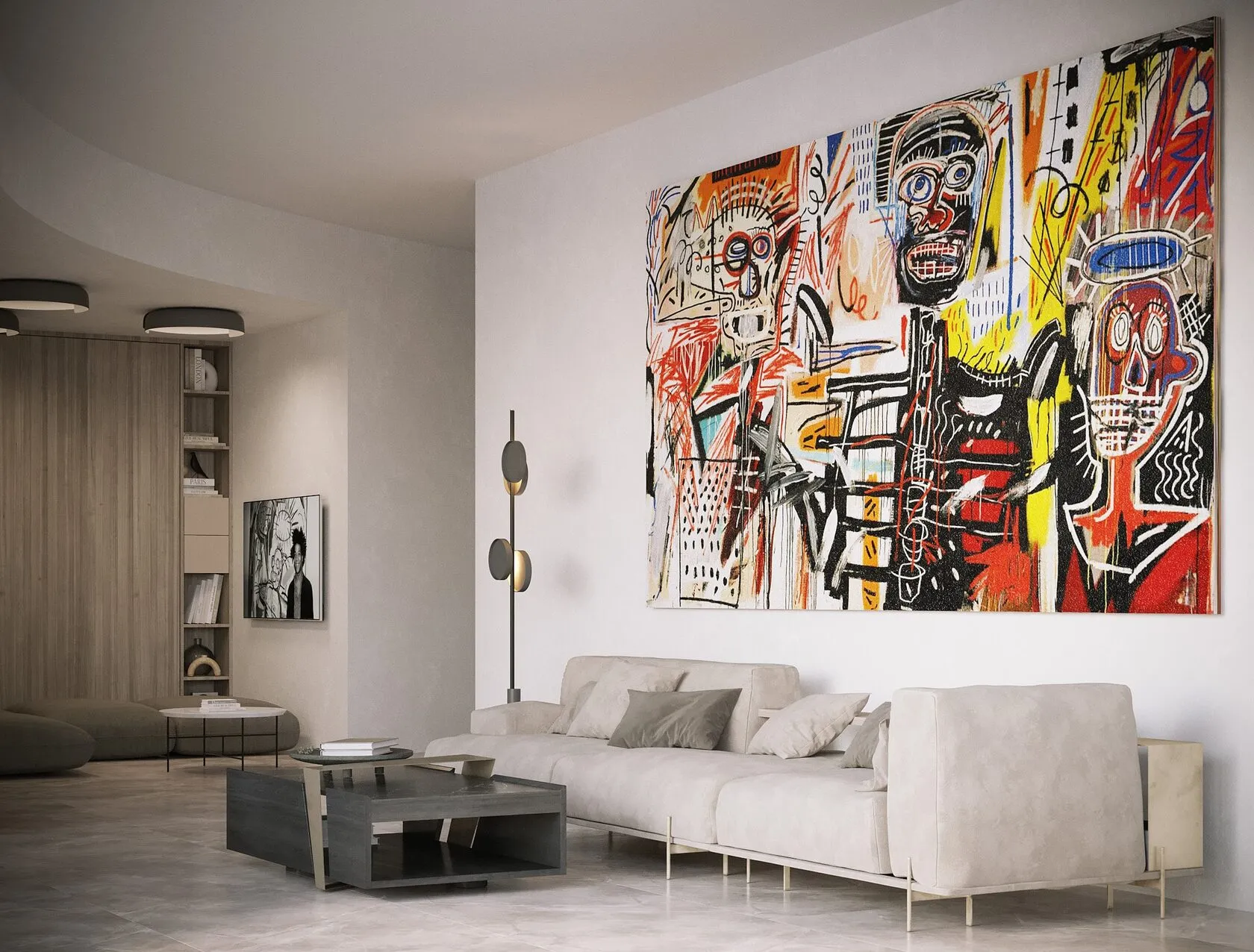
Designing a home around an art collection means letting the works decide where the walls, the light and the furniture go, instead of finding space for them once the house is finished. In Miami that question comes up often. Many of the people who buy apartments and villas on this coast also collect, and every December Art Basel brings galleries and collectors from around the world to Miami Beach. Interior design for art collectors is the work I care about most, and I approach it as a painter as much as a designer: I trained as a monumental artist before I designed my first interior, and I still think of a room as something built around what hangs in it.
Start with the works, not the walls
I grew up among people who made and repaired art. My family worked in sacred art, I spent my childhood in a restorer’s workshop, and I studied monumental painting at the Repin Academy of Arts in St. Petersburg: murals, mosaic and stained glass, the arts that belong to a specific wall in a specific building. That training shaped how I see a house. A painting is not a finishing touch. It has a size, a weight, a surface that reacts to light and humidity, and a distance from which it wants to be seen.
Most interiors are designed the other way around. The architect fixes the windows, the electrician places the outlets, the decorator chooses the sofa, and only then does someone ask where the large canvas will go. The answer is usually the one wall that is left, under a downlight that was placed for a coffee table.
When the collection comes first, the house changes. Walls get the right length and height for particular works. Windows move so that sunlight never falls on the most fragile piece. Ceilings carry track or recessed fittings aimed at specific positions. Furniture becomes quieter, and the works become the reason the room exists.
A method: designing rooms around specific pieces
Here is how I do it, in order.
- Inventory the collection. For every work: dimensions with the frame, weight, medium, glazing and sensitivity to light and humidity, usually starting from the owner’s or the art advisor’s records.
- Decide what lives where. Not every piece needs a permanent wall. I separate the works that define the house, which get their own walls, from those that will rotate, which get flexible zones.
- Draw the viewing scenarios. A large abstract canvas wants distance; a small drawing wants to be found up close, on a stair or at the end of a corridor. The plan follows those lines of sight.
- Shape the walls and ceilings around the pieces. A wall slightly wider than the work, a niche cut to the depth of a sculpture, a ceiling raised to give a tall canvas air above it.
- Place the light and the services after the art, not before. Lighting positions, outlets, switches, thermostats and air vents are moved so they never land on or right beside a work.
- Check in VR. We place the works at real scale in the virtual model and walk through the house before construction, so the owner can see a canvas from the sofa and from the door before a wall is built.
If you advise collectors or run a gallery and are looking for a designer for a client’s home, we are glad to work alongside you from the first inventory onward. Get in touch.
Light that serves the art
Light is the part of a collector’s house that most decides how the art looks and how long it lasts. The two goals pull in different directions, so the design has to satisfy both.
To see the work well, the light must render color truthfully and arrive without glare. I use LED fixtures with a color rendering index of 90 or higher and a warm-neutral color temperature, usually around 2700 to 3000 kelvin in a home, so the art and the room share the same light. A study for the U.S. Department of Energy at the Getty Museum found that the LED tested emitted no ultraviolet or infrared at all. Fixtures are aimed from the ceiling at an angle that keeps reflections out of the viewer’s eye, which matters most with glazed works and glossy paint.
There are two main ways to light a wall. Accent lighting, from adjustable track heads or recessed spots, picks out individual pieces and suits a house where works move. A wall wash spreads even light over the whole surface and suits a long wall with a hang that will stay for years.
To protect the work, the light must be limited. Daylight through ordinary window glass still carries a high dose of ultraviolet, and in a Miami apartment with floor-to-ceiling glass that is the main risk. UV-filtering film on the windows, UV-filtering acrylic or museum glass on works on paper, and blinds that close when the sun is on the wall do most of the work. The rest is placement: the most light-sensitive works hang where the sun never reaches.
Scale, sightlines and where the eye rests
A work that is too small for its wall looks lost; one that is too large for its room cannot be seen whole. My working rule is that a single painting should occupy roughly half to two-thirds of the width of the wall it owns, and that the viewer should be able to stand back at least one and a half times the work’s largest dimension.
Hanging height is where opinions differ most. Museums center works between about 56 and 60 inches from the floor, roughly eye level for a standing adult: the Hilliard Art Museum uses 60 inches, the South Dakota Art Museum 56. At home I start from that standard for walls you pass while standing, such as halls and stairs, and lower the hang in rooms where you sit, so that a painting above a sofa or a dining table relates to people seated in front of it. A group of works is hung as one composition, with the center of the whole group at that height rather than each piece separately.
Sightlines tie the house together. I like to place a strong work at the end of each long view: through a doorway, at the turn of a stair, at the far end of an enfilade. Then the house rewards movement, and every room has a place where the eye comes to rest.
Sculpture, objects and furniture that holds its own
Sculpture needs space around it more than a wall behind it. A piece meant to be seen in the round should be reachable on all sides, which means planning a clear circle in the floor plan, not a corner. Plinths are part of the work’s presentation: their height, depth and material decide whether the eye meets the sculpture where the artist intended. I design them to the piece, usually in plaster, stone or wood that matches the room, so they disappear and the object remains.
Heavy works need structure. Stone or bronze on a plinth, or a large piece on a wall, may need reinforcement in the floor slab or blocking in the wall, which is far easier to arrange before the finishes go in. In a condominium this also involves the building’s rules and engineers.
The furniture around a collection has two possible roles. It can step back: low, plain, in the colors of the walls. Or it can stand as an object in its own right. Our own pieces, made under the Timroom Furniture name, are designed for the second role; we think of each one as a sculpture for everyday life. Lighting can play the same part. In our La Perla project the decorative fixtures were chosen to act as art objects, not only as sources of light.
The rule I follow is that no more than one element in a field of view should compete with the main work. If the sofa is a sculpture, the painting above it should be quiet, and the other way round.
Why collectors are rethinking their homes now
Art Basel Miami Beach in December 2025 brought 283 galleries from 43 countries and territories and more than 80,000 visitors to the Convention Center; the 2026 edition runs December 4 to 6. The market is growing as well: the Art Basel and UBS Art Market Report 2026 put global sales for 2025 at $59.6 billion, up 4%, with the United States accounting for 44% of the total. Dealers also reported that almost half of their 2025 buyers were new to them.
The Pérez Art Museum Miami is showing Basquiat: Figures, Signs, Symbols through June 2027, and a show of Picasso, Klee and Matisse from the Museum Berggruen opens this fall.
In my experience the standard at home has changed too. Owners now ask for museum-grade glazing, controlled humidity and lighting designed for particular works, and they want all of it without the house feeling like an institution.
Art in a Miami climate: humidity, salt air, glare
Miami’s climate is hard on art in three ways, and a collector’s house should answer all three.
Humidity. Conservation guidance from the Canadian Conservation Institute and museum standards converge on a stable relative humidity of about 40 to 60%, with 50% as a common target. Mold can start on vulnerable materials at around 70% humidity if it lasts long enough, and much faster above 80%. Stability matters as much as the number: canvases and especially wooden panels swell and shrink with every swing, and daily fluctuations do more harm than a slow seasonal drift. The Getty Conservation Institute notes that in hot, humid regions air conditioning alone does not reliably produce the right conditions, and an oversized unit switches off before it has removed enough moisture. In a collector’s home I ask for dedicated dehumidification, sensors in the rooms with the most sensitive works, and an air-conditioning design that runs steadily rather than in bursts.
Salt air. Chlorides in household dust speed up the corrosion of metal, from bronze sculpture to the hardware on a frame, and near the ocean that dust carries salt. Iron begins to rust at around 65% humidity. Metal works belong away from open terraces, in the driest rooms of the house.
Glare and ultraviolet. The same panoramic glass that makes an oceanfront apartment desirable floods it with ultraviolet. Window film, UV-filtering glazing on the works, and planning which walls ever receive direct sun are the defenses described above.
The table below summarizes the published conservation guidance. The figures are museum standards; a conservator can advise on a specific work.
| Medium | Recommended light level | Relative humidity | UV protection |
|---|---|---|---|
| Works on paper, watercolors, photographs, textiles | About 50 lux; rotate, do not display permanently | Stable 40–60%, mold risk above ~65–70% | UV as close to zero as possible, never above 75 µW/lm; UV-filtering glazing |
| Oil and acrylic paintings on canvas | About 150 lux | Stable 40–60%, avoid daily swings | UV-filtering glazing or window film; no direct sun |
| Paintings on wood panel | About 150 lux | Stable 40–60%, the most sensitive to fluctuations | As for paintings on canvas |
| Stone, ceramics, glass | Up to about 300 lux | Less sensitive; keep dust and salt off surfaces | Low priority |
| Metal, including bronze | Up to about 300 lux | Driest rooms; iron rusts above ~65%; mixed metal collections 35–55% | Low priority; protect from salt-laden air |
Sources: Canadian Conservation Institute, light and paintings; CCAHA; National Park Service, Conserve O Gram 3/4; CCI, storage of metals.
Commissioning art for the house itself
A collection is made of works that could hang anywhere. Some of the most memorable art in a house is the opposite: made for one wall, one ceiling, one window, and impossible to move without destroying it. This is the kind of art I was trained in.
A site-specific work can take several forms:
- a mural painted directly on plaster, in mineral or lime-based colors that become part of the wall;
- a mosaic in stone or glass smalti, for a floor, a shower, a pool wall or the back of a fountain;
- a stained-glass window or screen, where the light itself becomes the medium and changes through the day;
- a relief in plaster or stone, which needs only raking light to come alive.
The process starts like any design project, with the place. I look at how light falls on the surface at different hours, how far away people will stand and what the owner wants the work to hold. Then come sketches and samples at real scale on site, and only after that the work itself, painted or set by hand. In Miami the technical choices follow the climate: materials that tolerate humidity and salt, and surfaces prepared so the work lasts as long as the house.
In the Amazing Space yoga studio we designed two such pieces into the space itself. A mandala carved by hand from solid wood sits at the center of the main practice room and is the first thing you see from the door. Upstairs, a stained-glass panel with the image of the moon catches the sun during the day and fills the room with a warm glow in the evening.
A commissioned work also solves a problem collectors often have. The great piece you own may be too fragile for the sunny loggia or the humid pool house. A mosaic made for that place will not be.
If you are thinking about a mural, mosaic or stained glass for your home, tell us about the wall and the light it receives. You can see more of my background in monumental art on the About page.
A gallery by the ocean: Armani Casa, Sunny Isles
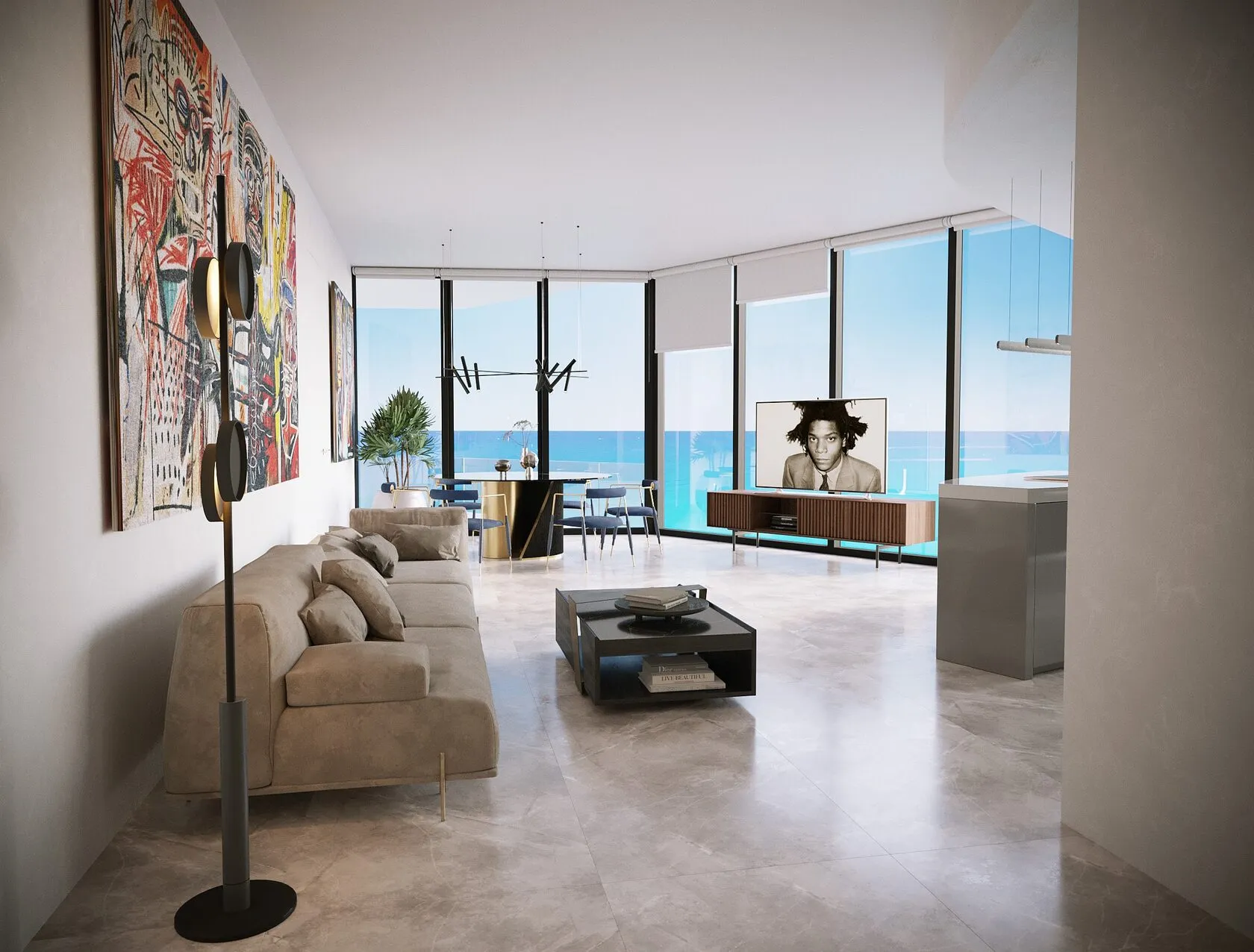
Our residence at the Residences by Armani/Casa in Sunny Isles Beach was conceived as a living gallery by the ocean. The owner collects contemporary art, and the brief was a home that works as a backdrop for the collection while staying comfortable for family life with children.
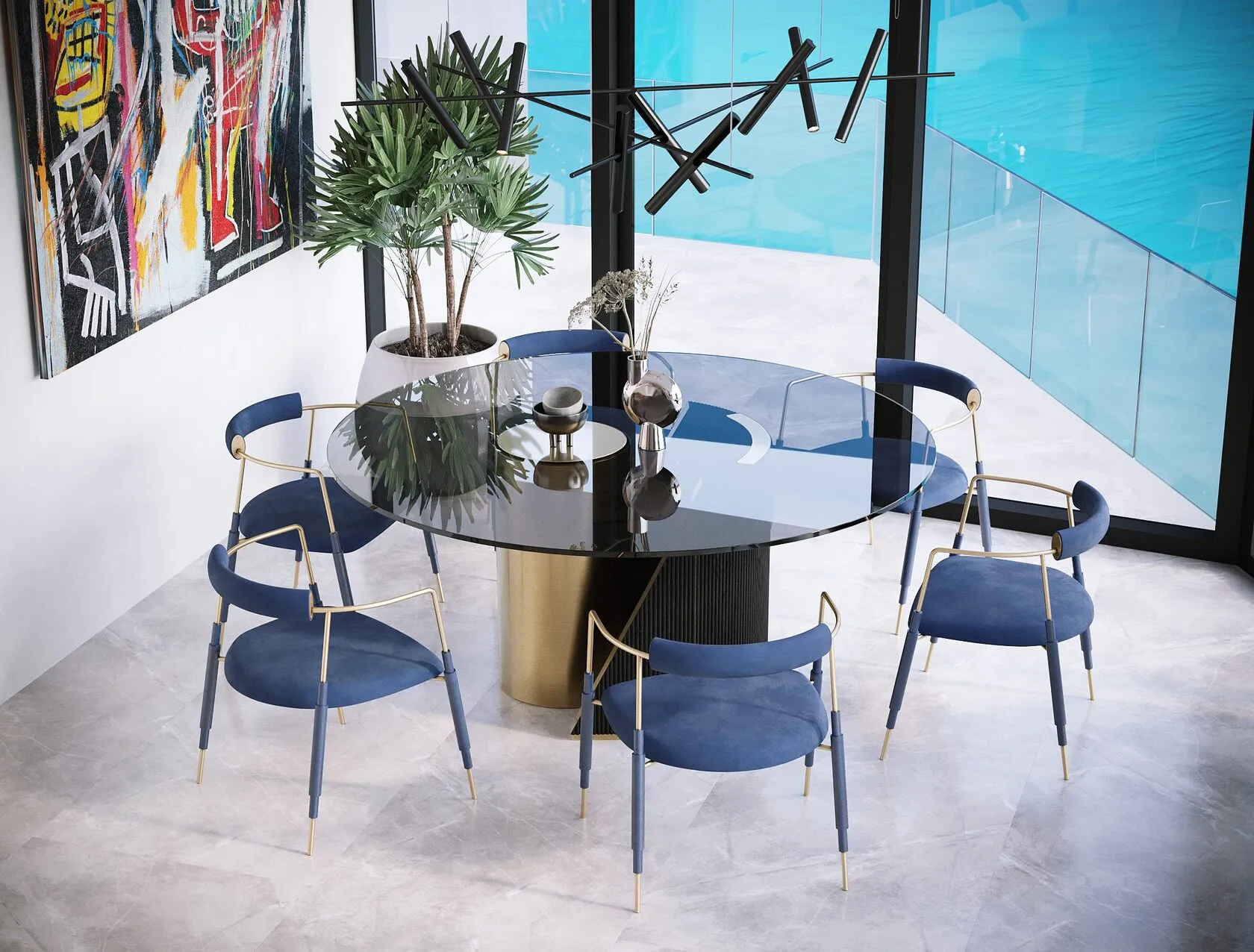
We chose some of the works together with the client at a gallery, then planned the hanging so each piece has room to breathe. The walls are finished in neutral Venetian plaster: it gives them soft depth without competing with the large, expressive canvases. Blue runs through the apartment, from the velvet dining chairs to the bedroom rug, and ties the rooms to the ocean outside, while walnut, dark wood and brass add warmth to the cool palette.
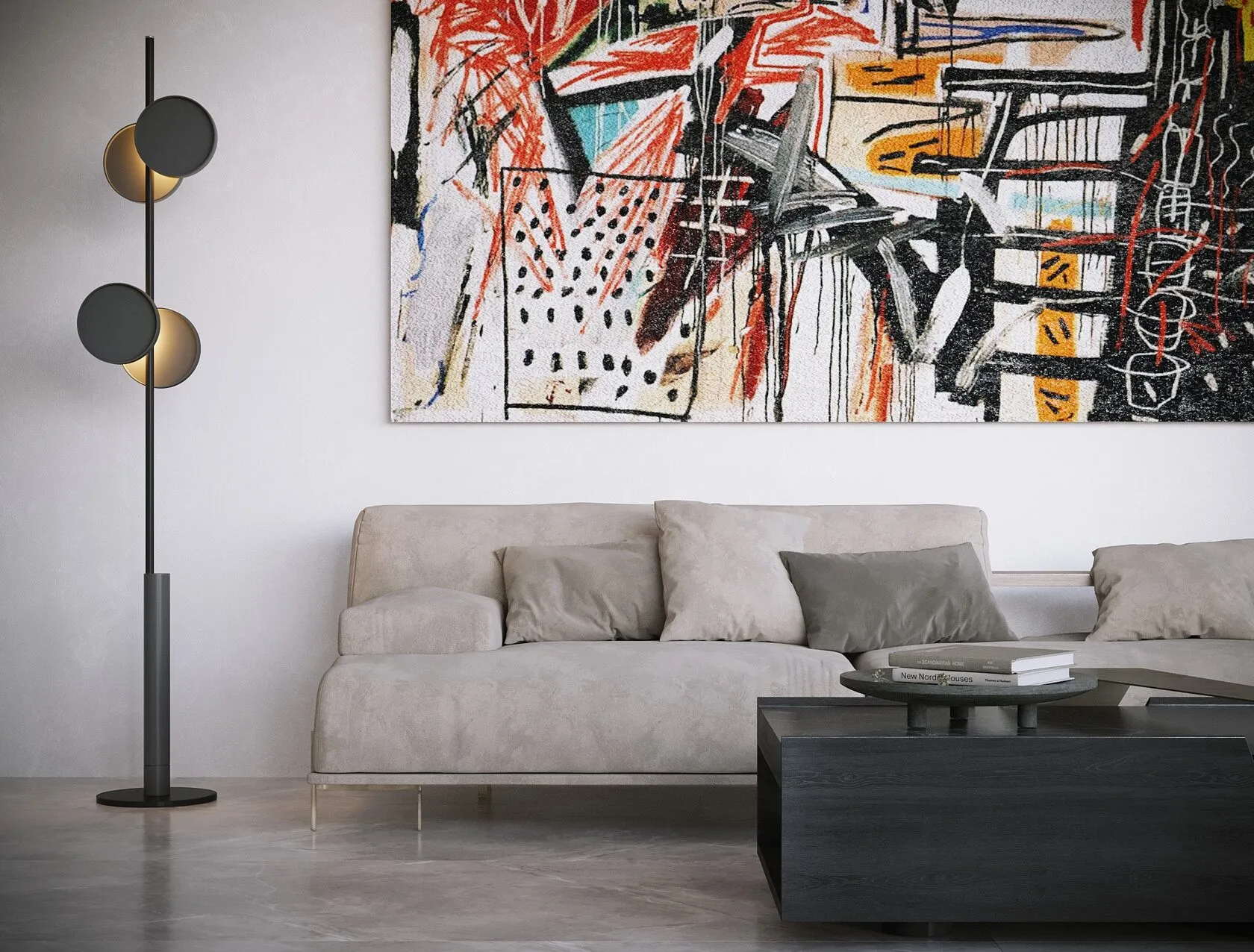
The hardest part was the plan. The apartment opens to panoramic ocean views, but it is full of angles, corners and curved ceiling lines, so the furniture had to keep the views open and the walls free for art. Every decision was checked against one question: does this help the works, or compete with them? The project took five months and was completed in 2021.
Living with a collection that changes
A collection is never finished. Works are bought, lent to exhibitions, sent for conservation, and some should not be shown all the time: conservation centers recommend displaying highly light-sensitive works such as drawings, prints and photographs for limited periods and then resting them in the dark. A house designed only for today’s hang will be wrong in three years.
So I build flexibility into the architecture.
- Plywood blocking behind the plaster along the main walls, so a heavy work can hang anywhere without searching for studs, and a discreet picture rail or cable system where the hang will change often.
- Track or adjustable recessed fittings rather than fixed spots aimed at one frame.
- A climate-controlled storage room with vertical racks, at the same humidity as the rest of the house, so a work that comes off the wall goes into the same conditions it lived in.
- A plan of every wall with the positions, weights and lighting settings for each work, kept with the owner’s inventory, so a change of hang is a decision rather than a guess.
With this in place, rotation becomes part of the pleasure of owning art, and works that rest in the dark for part of the year come back to the walls looking as they did when they were bought.
About the author
Timofei Pivnik is an interior designer, a monumental artist and the founder of Timroom, a studio in Miami Beach. He is a member of the American Society of Interior Designers (ASID) and received a Silver award at the 2025 International Design Awards (IDA). He graduated in monumental art from the Repin Academy of Arts, where he worked in mural painting, mosaic and stained glass, and received a gold medal of the Academy of Arts. He has designed interiors since 2012: more than 150 projects and over 86,000 square feet. More about Timofei and the studio.
Frequently asked questions
How do you design a room around a piece of art?
Start from the work: its size, medium and sensitivity to light. Decide where it will be seen from, give it a wall of the right width, plan the lighting for that exact position, and keep vents and direct sun away from it.
What is the best lighting for art at home?
LED fixtures with a color rendering index of 90 or more and a warm-neutral color temperature, around 2700 to 3000 K, aimed to avoid glare. Keep works on paper at low light levels, around 50 lux.
How do you protect art from humidity in Florida?
Keep relative humidity stable, around 40 to 60%, with dedicated dehumidification and sensors rather than relying on air conditioning alone. Avoid hanging works on walls that get direct sun or near air vents and terrace doors, and keep metal pieces away from salt air.
At what height should art be hung?
Museums center works between about 56 and 60 inches from the floor. At home, that height suits halls and stairs; in rooms where people sit, hang a little lower so the work relates to seated eye level, and treat a group of works as one composition.
Can an interior designer commission artwork for my home?
Yes. A designer can commission or create site-specific work, such as a mural, mosaic, stained glass or relief, made for a particular wall and its light. At Timroom this is part of the founder's own training as a monumental artist.
What does it mean to design a home around an art collection?
It means planning walls, light, climate control and furniture from the works outward, so the architecture serves the collection instead of the art filling leftover space.