Art Deco Interior Design: How to Bring It Into a Modern Miami Home
Art Deco interior design from Paris 1925 to Ocean Drive, and how to bring it into a modern Miami home without pastiche. Notes from a monumental artist.
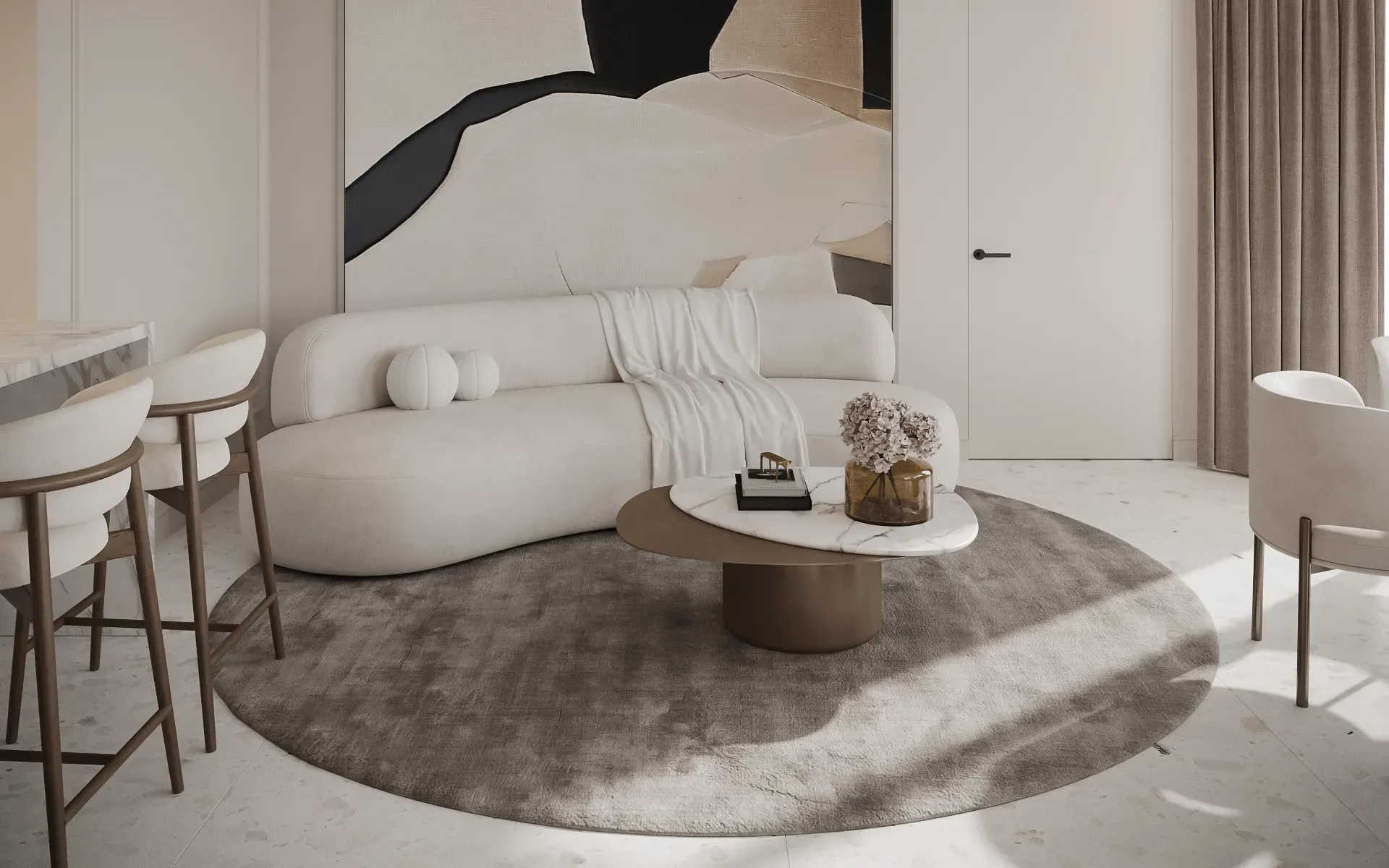
Art Deco interior design is the most Miami of all historical styles, and the easiest to get wrong. Walk down Ocean Drive and you understand why people love it: geometry you can read from across the street, glamour that never takes itself too seriously. Bring the same vocabulary into a contemporary condo at full volume, and the result looks like a hotel lobby, or a Gatsby party that never ended.
I trained as a monumental artist at the Repin Academy of Arts, in wall painting, mosaic and stained glass, before I designed my first interior. Art Deco is the style where that training matters most, because the original interiors were built around exactly those crafts. In this guide I cover what the style is, where it came from, why it is back under a new name, and how I bring it into a modern home so it reads as yours rather than as a period set.
What Art Deco interior design is
Art Deco interior design is the decorative style of the 1920s and 1930s, built on geometry, symmetry and costly, polished materials. It took the clean lines of the machine age and dressed them in marble, lacquer, brass and rare woods. Where earlier styles imitated nature, Deco stylized it: a sunrise became a fan of rays, a wave became a zigzag, a palm became a vertical rhythm of lines.
Three ideas hold the style together. Order comes first: rooms are composed around an axis, with pairs of lamps, chairs and doors mirrored on either side. Contrast comes next: black against white, gloss against matte, warm metal against cool stone.
And ornament always has a job. Deco never gave up decoration the way Modernism did. It concentrated it in a few places, a frieze above a door, a pattern in the floor, a panel of etched glass, and kept everything around it calm. That last idea is the key to using the style today.
Where it came from: Paris 1925, New York, and Miami Beach
The style takes its name from the 1925 Exposition internationale des arts décoratifs et industriels modernes in Paris. French decorators showed lacquered furniture, glass and metalwork there as a new, modern kind of luxury. Nobody called it Art Deco at the time: the term caught on only in the late 1960s, and the historian Bevis Hillier’s 1968 book fixed it for good.
The United States did not exhibit in Paris, yet it became the style’s second home. In New York, Deco moved from the salon to the skyscraper. The Chrysler Building lobby, finished in 1930, is a complete Deco interior: red Moroccan marble walls, elevator doors inlaid with wood, and Edward Trumbull’s ceiling mural Transport and Human Endeavor, painted on canvas and then fixed to the ceiling. Radio City Music Hall followed in 1932. In both buildings, art was not hung on the walls. It was the wall.
Miami Beach came last and made the style its own. Through the 1930s, architects such as Henry Hohauser and L. Murray Dixon built hundreds of small hotels and apartment buildings in what is now South Beach. Budgets were modest, so they used stucco instead of marble and took their imagery from the place: flamingos, palms, waves and sea life. This is Tropical Deco. Later in the decade came Streamline Moderne, with rounded corners, horizontal racing stripes and porthole windows borrowed from ocean liners.
By the 1970s many of these buildings were run down and threatened with demolition. In 1976 Barbara Baer Capitman and designer Leonard Horowitz founded the Miami Design Preservation League, and on May 14, 1979, the district entered the National Register of Historic Places. It was the first urban 20th-century district in the country to be listed, with more than 800 buildings (Florida historical marker). Today the Art Deco Historic District holds the largest concentration of Deco architecture in the world, and it sits a few blocks from our studio on Miami Beach.
Neo Deco: why Art Deco is back in 2026
Art Deco has come back roughly once a generation. The first revival came in the late 1960s, when the style finally got its name. The second came in the 1980s, when Miami Beach repainted its hotels and the whole country saw Ocean Drive on television. The third is happening now, and it has a name of its own: Neo Deco.
Pinterest named Neo Deco one of the home trends in its Predicts 2026 report, describing chevrons, fan arches and other geometry trimmed in chrome or brass. Searches for “brass aesthetic” and “leather banquette” each grew 35 percent year over year (Apartment Therapy). At Salone del Mobile in Milan in April 2026, the same language ran through the fair: Armani Casa showed a games table in ebony and satin brass, Louis Vuitton reissued Pierre Legrain’s 1921 Omega table, and Tacchini brought back Tobia Scarpa’s lacquered Pigreco chair (Yanko Design).
Three things brought it back:
- A centenary. The 1925 Paris exposition turned one hundred, and the Musée des Arts Décoratifs marked it with 1925–2025: A Century of Art Deco, nearly 1,000 works on show from October 2025 to April 2026 (Paris je t’aime).
- Fatigue with beige. After a decade of pale oak, linen and quiet Scandinavian minimalism, people want rooms with structure, contrast and a clear identity.
- A return to craft. Lacquer, fluting, burl veneer and inlay reward skilled hands, and clients now value pieces that look made rather than manufactured.
Neo Deco is not a copy of the 1930s. Its forms are softer and more sculptural, its layouts cleaner, and its ornament scarcer. Gloss, velvet and marble appear in doses, next to plain plaster and natural wood. The focus has moved from surface decoration to silhouette, proportion and joinery.
I don’t design Neo Deco as a trend. Trends date a home quickly, while the principles under this one, order, contrast and ornament used with purpose, have outlived three revivals. In Miami, Deco never really left. What changes from one revival to the next is the dose, and that is what the rest of this guide is about.
The defining features: geometry, symmetry, materials
You recognize Art Deco in a room by a handful of features. They rarely appear all at once, and in a modern interior they should not.
- Geometric patterns: chevron, zigzag, stepped ziggurat profiles, fans and the sunburst.
- Symmetry: a central axis, mirrored pairs, a strong focal point at the end of a view.
- Streamlined forms: rounded corners, curved sofa ends, horizontal banding.
- Statement lighting: tiered ceiling fixtures, frosted-glass and alabaster shades, sconces in pairs.
- Mirrors and reflection: mirrored panels, beveled edges, polished floors that double the light.
- Fluting and reeding: vertical grooves in wood, plaster and glass.
The materials do as much work as the shapes. The Paris decorators used macassar ebony, lacquer, shagreen and gilt bronze. New York added chrome, steel, black glass and boldly colored marble. Miami Beach worked with what it had: terrazzo, keystone, glass block and etched glass. Velvet ties all three together, usually in deep, saturated colors.
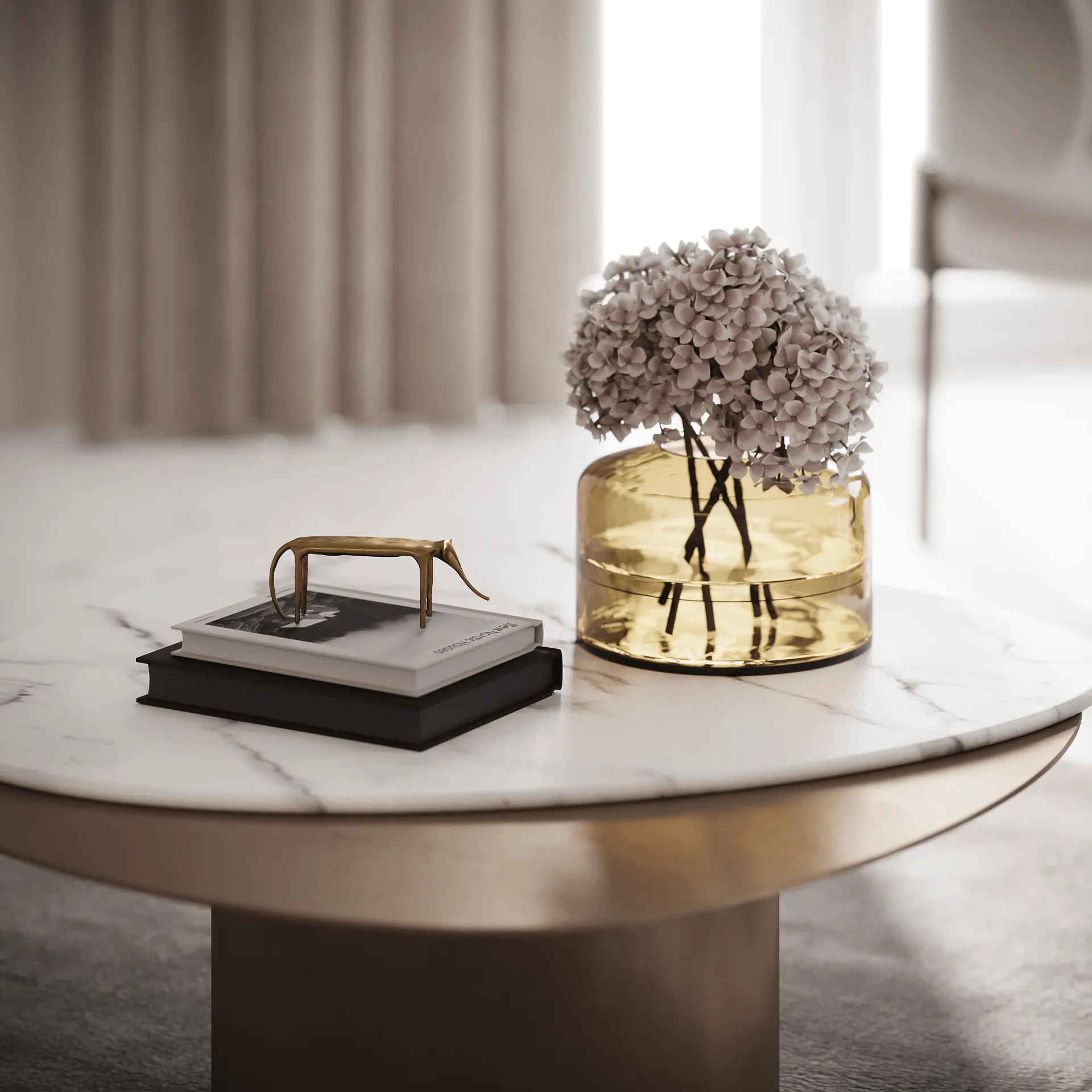
Color: from jewel tones to Miami pastels
The original Art Deco palette is darker than most people expect. Paris and New York favored black and white in high contrast, then emerald, sapphire, deep red and amber set against gold or silver. These jewel tones read as Deco in any room.
Miami’s pastels have a more recent story. In the 1930s most Ocean Drive buildings were white or off-white, with subtle colored trim. The pinks, mints and lavenders arrived in the late 1970s and early 1980s, when Leonard Horowitz composed a palette inspired by the local sunrises, sunsets, ocean and sand to draw attention back to the architecture during the fight to save it (MDPL archive). It worked, and it became the image of the city.
For an interior, this gives you two honest routes. One is classic: a dark, saturated base with metal and stone. The other is Miami: a white or warm-white shell, with color used the way the original architects used it, as trim, inlay and accent.
I rarely recommend painting a modern living room in full pastel. In our light, large pastel walls look sweet by noon. Pastel in a terrazzo chip, a glass panel or a lacquered niche keeps its charm for years.
Classic, Tropical and Neo Deco at a glance
The three versions share a grammar of geometry and contrast but differ in palette, materials and the rooms they suit.
| Version | Period | Palette | Materials | Motifs | Where it works best |
|---|---|---|---|---|---|
| Classic Art Deco | 1920s–1930s, Paris and New York | Black and white, emerald, sapphire, gold | Marble, lacquer, macassar ebony, chrome, velvet | Sunburst, chevron, ziggurat, stylized figures | Dining rooms, bars, entry halls |
| Miami Tropical Deco | 1930s–early 1940s, Miami Beach | White shells with colored trim; pastels since the 1980s | Terrazzo, keystone, stucco, glass block, etched glass | Flamingos, palms, waves, eyebrows, portholes, neon | Bathrooms, lobbies, outdoor living |
| Neo Deco | 2020s | Warm neutrals with one saturated accent and one metal | Stone, PVD brass, fluted wood, burl veneer, performance velvet, epoxy terrazzo | Fan arches, fluting, rounded forms, geometric inlay | Condos, primary suites, powder rooms |
How to bring Art Deco into a modern interior without turning it into a period set
The difference between a modern Art Deco interior and a theme room is restraint. The original interiors were made for hotels, theaters and ocean liners, rooms people passed through for an evening. A home is lived in every day, so the volume has to come down.
My working rule is simple: one statement, two echoes, everything else quiet. The statement is the piece that carries the style in a room, such as a mural, a terrazzo floor with inlay, a fluted bar or a tiered chandelier. The echoes repeat its geometry at a smaller scale, in a cabinet pull, a mirror frame or the border of a rug. The rest of the room stays contemporary: clean upholstery, plain walls, natural light. If you can count more than three Deco references from one spot, the room has crossed into costume.
A few more principles I follow:
- Choose one metal and stay with it. Brass next to chrome reads as a showroom, not a home.
- Take the geometry, leave the reproduction. A sunburst in the parquet is enough. A copy of a 1930s armchair in the same room is too much.
- Use curves to soften. Rounded sofa ends and arched openings carry the Deco feeling without a single piece of ornament.
- Let the architecture lead. In a glass tower in Brickell or Edgewater, Deco works as interior detail. In a 1930s building in South Beach it can go further, because the shell already speaks the language. In a waterfront villa on Miami Beach, I keep it to accents: a powder room, a bar, the entry.
- Light it like a stage, live in it like a home. Deco needs layered light: a statement fixture, wall sconces, lit niches. Dimmers let the same room work for a dinner party and for Sunday morning.
La Perla, a 3,200-square-foot Miami interior we designed in 2025, shows the approach. The palette is ivory, soft beige and gold, and the materials are marble, brass, velvet and terrazzo. A curved sofa, curved dining chairs and wave-shaped light fixtures play against the strict geometry of the architecture. There is no zigzag and no sunburst in it, yet its Deco ancestry is clear.
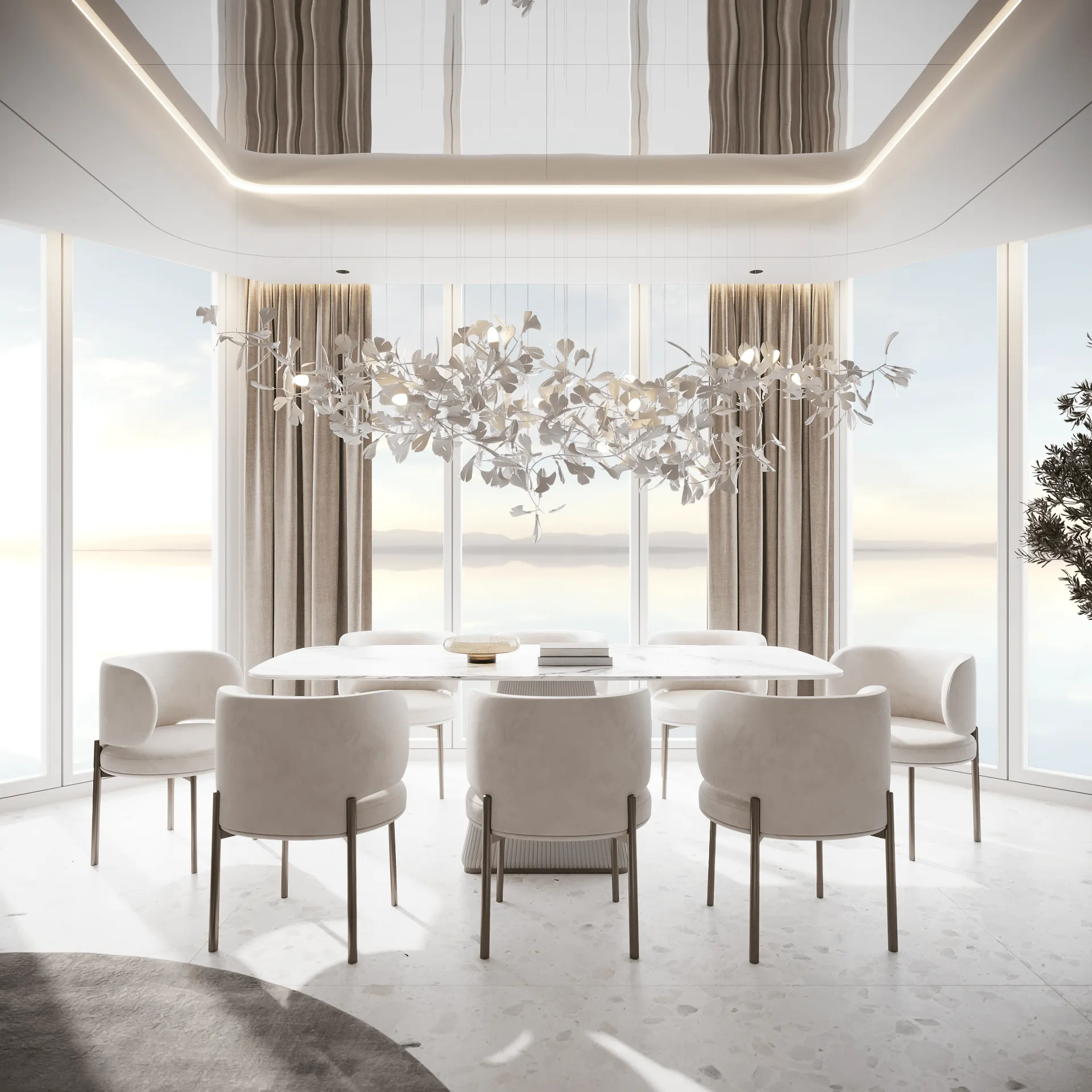
Two oceanfront apartments in Sunny Isles Beach use the same vocabulary in a bolder key. In Armani/Casa the main bedroom is built around an oversized backlit headboard wall: fluted black panels, soft beige suede, deep teal velvet and a brushed brass inlay. In the dining area, blue velvet chairs with slim brass frames surround a round glass table on a fluted brass base. In Acqualina we cut Panda marble into strips of varying widths for the fireplace wall, so its black-and-white veining reads as a rhythmic, almost graphic composition, the way a Deco designer would treat stone. Neither home looks like a period piece, yet fluting, brass, velvet and patterned stone are Deco’s own language.
Murals, mosaics and etched glass: the art inside Art Deco
Most guides to Art Deco list furniture and forget the art, yet the great Deco interiors were built around it. The Chrysler lobby has its ceiling mural. Rockefeller Center greets visitors with reliefs and mosaics above its entrances. In Miami Beach, lobbies along Ocean Drive and Collins Avenue still keep murals by the local painter Earl LaPan, terrazzo inlays at the door and glass etched with palms and flamingos (MDPL archive).
This is the part of the style closest to my own training. At the Repin Academy I specialized in monumental art: wall painting, mosaic and stained glass. Before I designed interiors, I made murals, mosaics and stained glass windows for homes and commercial spaces. So when a client asks for Art Deco, my first question is not about furniture. It is about the wall.
Glass is often the easiest place to start. In a yoga studio we designed, a stained-glass panel with the image of the moon lights the upper practice room: during the day it catches the sun, and in the evening it fills the room with a warm glow.
In a modern condo, this can take several forms:
- A painted mural in a dining room or entry, with stylized, flat forms rather than a realistic landscape. Painted on canvas and then fixed to the wall, the same way Trumbull’s Chrysler ceiling was installed, it can be taken down if you move.
- A mosaic panel behind a tub, a vanity or a bar, in glass or stone tesserae.
- Etched or sandblasted glass in a sliding door, a shower screen or a cabinet front, with a pattern drawn for that room.
- A plaster relief or frieze above a doorway or along a ceiling cove.
The order of work matters. We choose the wall and the theme first, then I draw the piece to scale inside the 3D model of the room, so the client sees it in virtual reality together with the lighting and the materials. Only then do we paint, set or etch. Designed this way, the artwork does not look added later. The room looks as if it were built around it, which is exactly how Deco worked in the first place.
Commission a mural or a Deco-accented interior. Tell me about the wall, the room and the feeling you want. I’ll draw the piece to scale in a 3D model of your home, and you’ll see it in VR before anything is painted or set. Start with a free consultation
Terrazzo, keystone and brass in a humid climate
Miami is hard on Deco materials. Salt air, humidity, round-the-clock air conditioning and strong sun all work against brass, velvet, lacquer and wood. The original Miami Beach builders knew this, which is why their lobbies used terrazzo and keystone rather than parquet and silk. In an oceanfront condo, the choice of material matters as much as the choice of motif.
Terrazzo is the floor of Miami Deco: chips of marble and glass set in a binder and ground smooth. Epoxy terrazzo is thinner and allows finer inlay and brighter color, so it suits interiors and lets you draw a sunburst or a border into the floor. Cement-based terrazzo is the better choice for terraces and outdoor areas. Both need sealing, and neither minds humidity.
Keystone is a coral limestone from the Florida Keys, full of fossil shells. Deco architects used it, sometimes tinted, around entrances and as cladding. Indoors it makes a beautiful fireplace surround or feature wall. It is porous, so seal it and keep it away from kitchen splashes.
Brass darkens within months in salt air. If you like a living patina, accept it and polish when you want to. If you want it bright, specify lacquered or PVD-coated brass for door hardware, faucets and anything near the terrace.
Velvet suffers more from sun than from humidity. Cotton and silk velvet fade quickly next to floor-to-ceiling glass. For sofas and chairs facing the window I use performance velvet with solution-dyed fibers, and keep natural velvet for rooms away from direct light.
Lacquer and wood need a stable climate. Solid wood moves as humidity changes, and high-gloss lacquer shows every crack. Veneer on a stable core, in a home kept at a steady humidity of around 50 percent, holds both its shape and its finish.
Marble and mirror have their own weak points. Polished marble etches from lemon juice and wine, so for kitchens and bars I prefer a honed finish. Mirror can lose its silvering in a humid bathroom, so its edges should be sealed and the glass rated for wet areas.
Art Deco room by room
Living room
Start with one piece: a curved sofa, a fluted console or a mural. Add a pair of sconces and a rug with a quiet geometric border, and keep the walls plain.
Dining room
The most natural Deco room in a home. A round or racetrack table, a tiered chandelier, velvet chairs and one lacquered or mirrored wall. If a home has room for a mural, it is usually here.
Bathroom and powder room
Here you can go furthest, because the room is small and closed. Black and white marble, a terrazzo floor with an inlaid border, fluted glass, a round mirror. The powder room is often where I suggest the boldest Deco gesture in the whole home.
Entry
In the 1930s the entry was the apartment’s own small lobby. A patterned stone or terrazzo floor, a pair of sconces and an etched glass panel set the tone before anyone sees the living room.
An apartment in a 1930s building
If you live in one of the original Deco buildings in South Beach, the best design often starts with what is already there. An original terrazzo floor can usually be ground, repaired and polished rather than covered, and glass block, porthole windows and etched glass deserve to stay. I design around them, with a modern kitchen and bath that don’t compete. Anything visible from the street, such as windows, is usually controlled by the building and the city, so check before you plan.
About the author
Timofei Pivnik is an interior designer and the founder of Timroom, an interior design studio on Miami Beach. He is a member of the American Society of Interior Designers (ASID) and received a Silver award at the 2025 International Design Awards (IDA). He trained in monumental art, including wall painting, mosaic and stained glass, at the Repin Academy of Arts and received the Gold Medal of the Academy of Arts. Since 2012 he has completed more than 150 interiors in the United States and Russia. More about Timofei
Frequently asked questions
What are the key elements of Art Deco interior design?
Geometric patterns such as chevron, zigzag and the sunburst; symmetry around a central axis; materials like marble, brass, lacquer and velvet; statement lighting and mirrors. In a modern interior, two or three of these in one room are enough.
What is Neo Deco?
Neo Deco is the current revival of Art Deco, named by Pinterest as a 2026 home trend and seen across Salone del Mobile in Milan. It keeps the geometry, brass and lacquer of the 1920s but uses softer forms, cleaner layouts and far less ornament, often next to minimalist architecture.
What is the difference between Art Deco and Art Nouveau?
Art Nouveau, roughly 1890 to 1910, follows nature: flowing asymmetrical lines, plant forms, handcraft. Art Deco, in the 1920s and 1930s, turns nature into geometry and embraces the machine age, with symmetry, straight lines and polished industrial materials. Nouveau curves like a vine; Deco curves like the fender of a car.
What is Miami (Tropical) Art Deco?
It is the version built in Miami Beach in the 1930s and early 1940s: stucco buildings with "eyebrow" sunshades, porthole windows, glass block, neon and motifs of flamingos, palms and waves. In Miami Art Deco interior design, that means terrazzo floors, etched glass and murals. The famous pastel colors were added in the late 1970s and 1980s.
Can Art Deco work in a small or modern condo?
Yes, if you concentrate it. Choose one statement, such as a mural, a terrazzo floor or a fluted bar, and let the rest of the condo stay calm. Mirrors and curved furniture also make a small space feel larger.
What colors are used in Art Deco interiors?
Classic Deco pairs black and white in high contrast with jewel tones such as emerald, sapphire and deep red, plus gold or silver. Miami Deco is white with pastel trim. Today the most livable version is a warm neutral base with one saturated color.